
Practice speaking Japanese
JLPT N5JLPT N4JLPT N3JLPT N2JLPT N1
- Café in Kyoto
- Buy a train ticket
- Check into a ryokan
- Ask for directions
 Vivavoce
KYOTO · A1
Japanese · Spanish · Thai · Cantonese
Order coffee in Kyoto, check into a hotel in Madrid, bargain at a Bangkok night market. Vivavoce puts you in real conversations with a patient tutor, corrects you gently, and brings your own mistakes back until they stick.
For iPhone, iOS 18 or later.
How it works
Lessons build up to speaking missions: short, real-life conversations with a tutor who stays in character.
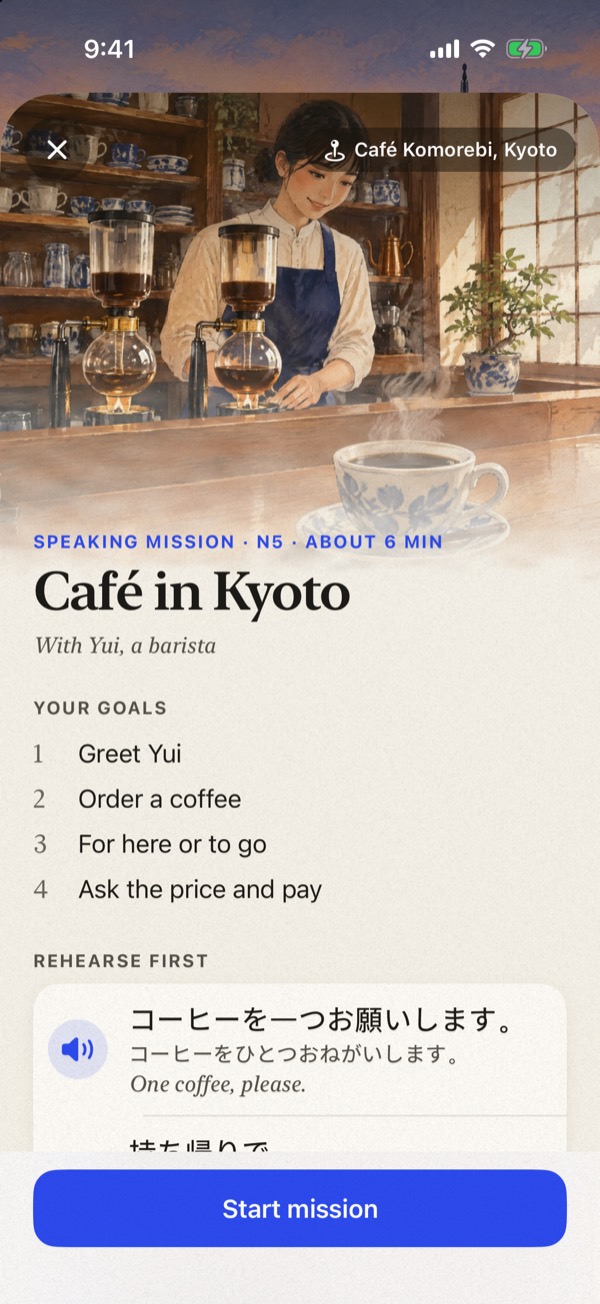
Each mission sets the scene, names your tutor and gives you a few goals, like greeting Yui, ordering a coffee and paying.
Hear each key phrase with its reading and meaning, then say it along before you go in. Rehearse as many times as you like.
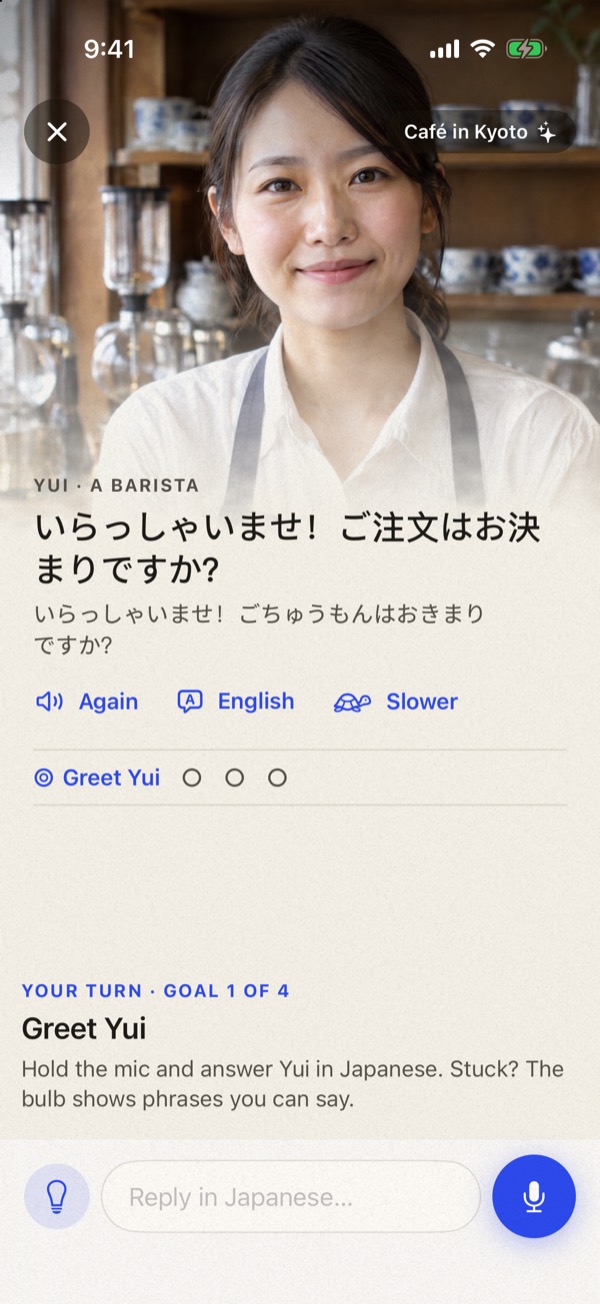
Talk or type. Ask your tutor to say it again, slow down, or show English. Goals tick off as you reach them.
Inside the app
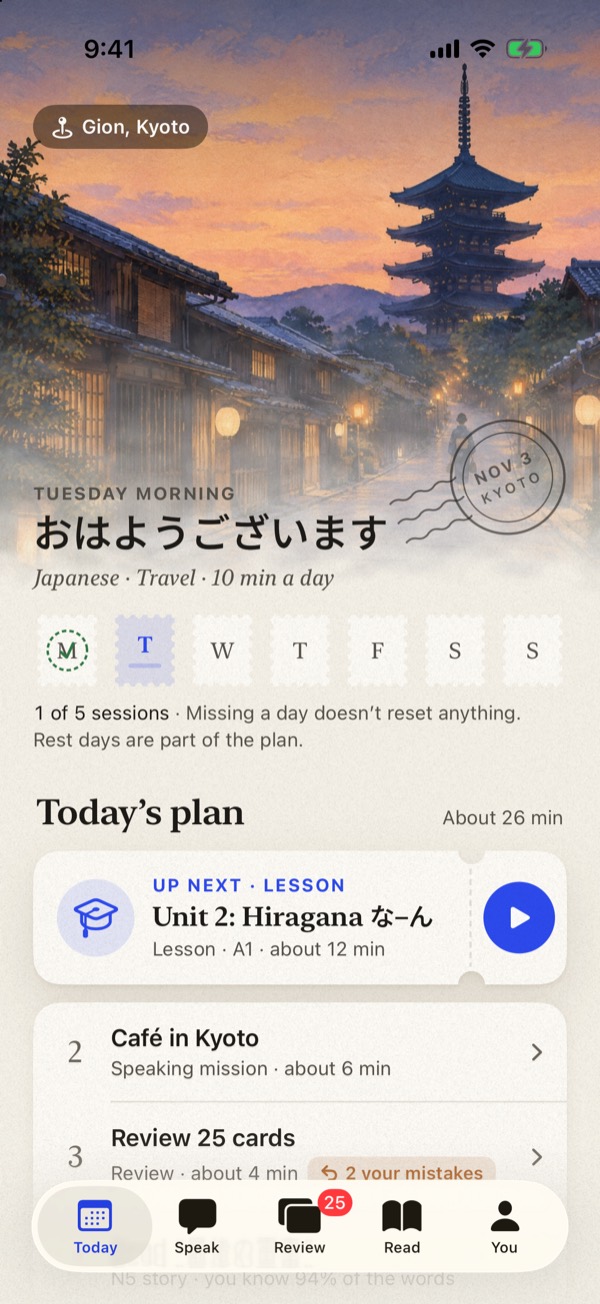
Gentle corrections
When you say something a native speaker wouldn't, a coach note appears under your message with the natural way to put it. The conversation keeps going, so you build confidence and accuracy at the same time.
Meet Yui, a barista at Café Komorebi in Kyoto, Lucía at Café Botánico in Madrid, Ploy at a coffee stall in Ari, Bangkok, or Ah Mei at Wing Lee Café in Sham Shui Po.
いらっしゃいませ!ご注文はお決まりですか?Welcome! Are you ready to order?
コーヒーをください。ホット。
More natural: ホットコーヒーを一つお願いします。 Saying “one hot coffee” as one phrase sounds smoother.
かしこまりました。Certainly.
Review
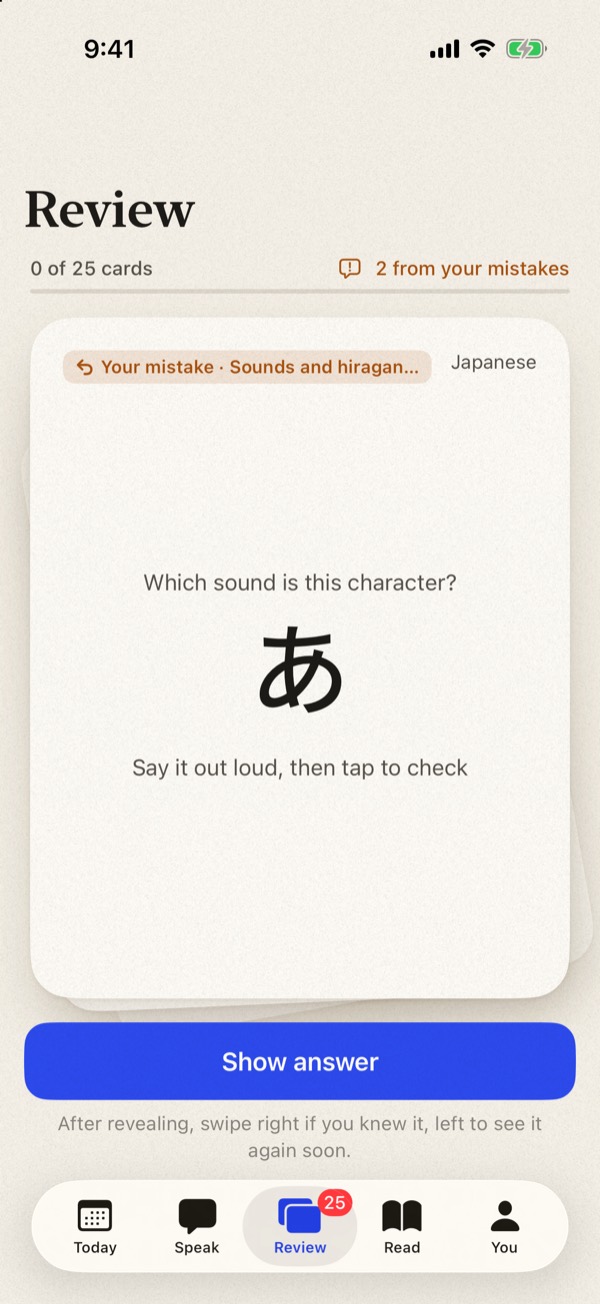
Every correction is saved. Review brings it back with spaced repetition, a little before you'd forget it, marked as your mistake and tagged with where it came from.
Say the answer out loud, reveal it, and swipe right if you knew it or left to see it again soon. Words from stories and lessons join the same deck.
Graded stories
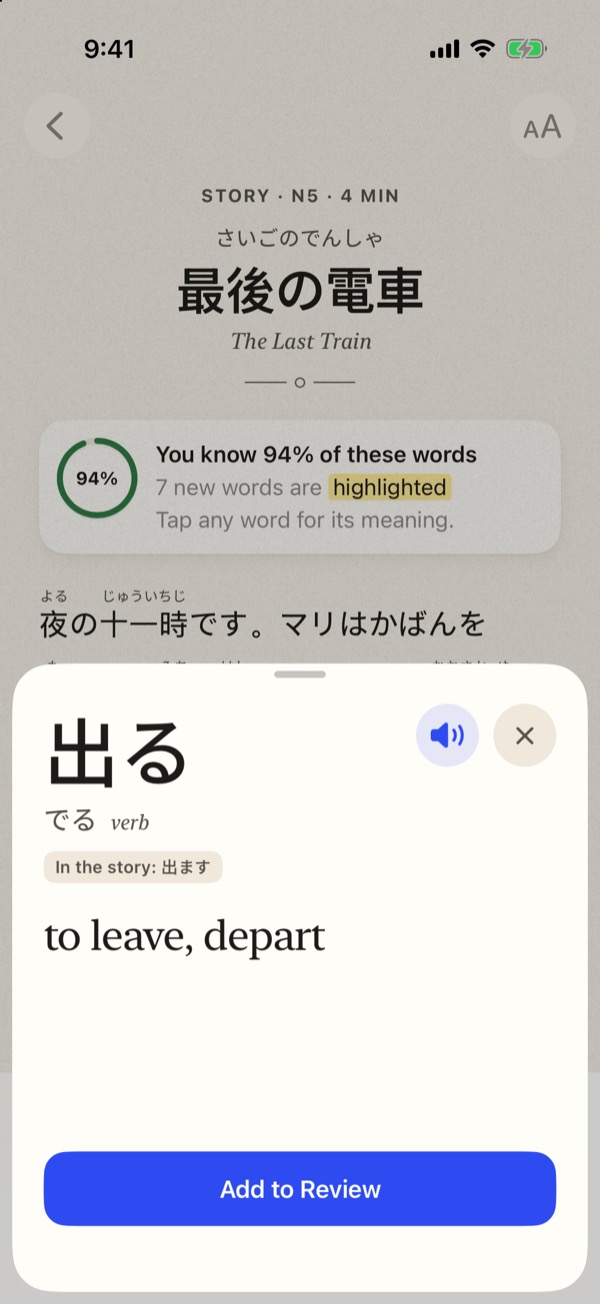
Stories are picked so you already know 90 to 98% of the words, like The Last Train (最後の電車, El último tren, รถไฟขบวนสุดท้าย, 尾班車). Tap any word for its meaning and an example, and listen while each sentence is read aloud.
Readings can show on every word, only on new words, or not at all: furigana for Japanese, romanization for Thai, Jyutping for Cantonese. New words are highlighted.

最後の電車 · The Last Train · N5
夜の十一時です。マリはかばんを持って、道を走っています。
It's eleven at night. Mari is running down the street with her bag.
Courses
Each course runs from A1 to C1 in 34 units, with its own tutors, places, missions and stories.



Your reason
Pick your reason when you start and set how many minutes a day you have. You can also write your own mission, like “meeting my partner's grandparents”.
New to speaking practice? Read why speaking practice and flashcards work best together.
FAQ
Japanese, Spanish, Thai and Cantonese. Each course runs from beginner (A1) to advanced (C1) in 34 units, with its own tutors, places and stories.
Yes. You can start at A1, rehearse each mission's phrases first, and ask the tutor to repeat, slow down or show English at any point.
A coach note appears under your message with the more natural way to say it, without stopping the conversation. Each correction is saved and comes back later as a review card.
Japanese levels follow JLPT N5 to N1 and Spanish levels follow DELE A1 to C1, so you can tell where you stand. Thai and Cantonese use the same A1 to C1 scale.
Vivavoce Premium is $119.99 a year, with a 7-day free trial, or $19.99 a month with no trial (US prices; the App Store shows the price for your country). You start the trial when you first open the app, and you're reminded before it ends. Cancel any time before the trial ends and you pay nothing. There are no ads.
Live role-plays with the tutor, played by Claude (two a day), a lesson and a graded story written for every unit, review built from your own mistakes, and all four languages. It runs on an iPhone with iOS 18 or later.
Yes. Stories can show readings on every word, only on new words, or not at all: furigana for Japanese, romanization for Thai and Jyutping for Cantonese.
Your first speaking mission takes about six minutes. For iPhone, iOS 18 or later.